If you’ve ever spent time in a data center, a corporate network closet, or a 5G telecom infrastructure hub, you’ve probably heard the terms MPO and MTP thrown around—often interchangeably, but with a quiet distinction I’ll get to later. As someone who’s been supplying MPO/MTP adapter cables for over a decade, I see first-hand how these little (but incredibly powerful) components hold up entire networks that keep businesses, healthcare facilities, and global communications running. Too often, people underestimate why these adapters matter, so let’s break down exactly what types of networks rely on MPO/MTP adapter cables, how they work, and why choosing the right one can make or break a network’s performance. MPO/MTP Adapter Cable
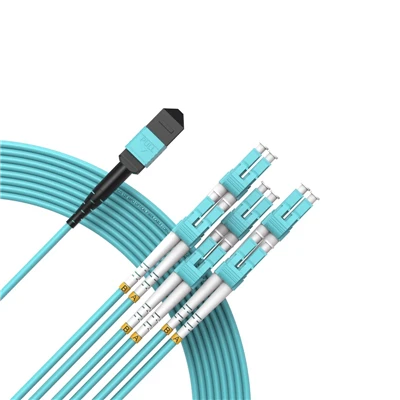
First, let’s clear up a common mix-up: MPO stands for Multi-fiber Push-On, the physical connector type, while MTP is a branded, high-performance variant of MPO created by US Conec. Think of it like the difference between a generic phone charger and an Apple MFi charger—same base design, but MTP is engineered for tighter tolerances, lower insertion loss, and more consistency, which is why it’s the go-to for demanding environments. Adapters for these cables act as the bridge between two MPO/MTP ports, letting you extend runs, split connections, or reorient fibers without damaging the sensitive core of the cable. Now, let’s dive into the networks that can’t function without them.
The big one, of course, is high-density data center networks. Today’s data centers aren’t the sprawling, low-density spaces of the early 2000s—now, a single rack might host 48 servers, each needing 12 to 24 fiber connections to upstream switches. Ethernet speeds have skyrocketed too: 10G, 40G, 100G, even 400G and 800G networks depend on parallel fiber connections, and MPO/MTP adapters are the only way to manage that many fibers in a single, compact run. Let’s do the math: a standard MPO cable carries 12 fibers, while a mini MP0 is 8, and high-density versions go up to 24. Without adapters, you’d have to run 12 separate duplex fiber cables for each connection, which would take up 12 times more rack space, cost way more in materials and labor, and introduce way more points of failure. I’ve worked with data center engineers who’ve told me switching to MPO/MTP adapter cables reduced their rack cabling footprint by 70%—that’s not just a win for space, it’s a win for airflow, cooling, and downtime reduction. These adapters also let data centers reconfigure networks on the fly, which is critical when a client suddenly needs to expand their server farm or shift traffic to a new edge location.
Next up: enterprise campus networks for large organizations. Think of a multinational corporation with a headquarters, 10 regional offices, and 20 remote branch locations. Each of these sites needs a robust backbone network to connect end-user devices, servers, and cloud services. For campuses with multiple buildings, the backbone runs between buildings, usually using single-mode fiber for long distances, but within a building’s wiring closet, multi-mode fiber is common for short, high-speed connections. MPO/MTP adapters simplify linking these two types—if a building’s closet uses MPO ports to connect to the campus backbone, and a server rack in the same closet has MTP ports to connect to local servers, an adapter lets you bridge that gap without replacing entire cable runs. I recently supplied MPO-MTP hybrid adapters to a retail company that was upgrading its entire North American campus; they were able to reuses 80% of their existing MPO cable infrastructure and just swap in adapters to match the new MTP ports on their switches, saving them over $50,000 in cabling costs and four weeks of installation time. For enterprises, that kind of flexibility makes MPO/MTP adapters non-negotiable.
5G and telecom networks are another huge, fast-growing market for MPO/MTP adapter cables. 5G relies on dense networks of small cells, distributed antenna systems (DAS), and core routers, all of which need to transmit massive amounts of data with minimal latency. A single small cell might have 6 to 12 fiber connections linking it to the core network, and MPO/MTP cables let technicians pull all those fibers into a single, compact run from the small cell to the macro tower or nearby closet. Adapters here are especially important because telecom environments are harsh—they’re exposed to extreme temperatures, dust, and frequent physical access for upgrades or repairs. I’ve had telecom clients ask for ruggedized MPO adapters with metal housings instead of plastic, because plastic ones crack when you’re working in freezing winter weather on a cell tower. These adapters also support the high speeds 5G requires: 100G and 400G backhaul links, which can’t work with older duplex fiber setups. Without MPO/MTP adapters, telecom providers would have to run dozens of separate cables for each small cell, cluttering up towers and making maintenance nearly impossible.
Then there’s healthcare networks, which have unique, non-negotiable requirements: reliability, security, and low latency. Hospitals and clinics rely on network connections for everything from electronic health records (EHR) and medical imaging (like MRI and CT scans) to telehealth consultations and life-support monitoring equipment. A network outage in a hospital can have life-threatening consequences, so their infrastructure is designed with redundancy and easy maintenance in mind. MPO/MTP adapter cables fit perfectly here because they let IT teams create redundant connections without disrupting the entire network. For example, if a primary fiber run fails, a technician can swap in a spare MPO adapter to switch to a backup cable in minutes, instead of having to rerun a new cable. I’ve supplied MPO adapters to a children’s hospital in the Midwest that needed to upgrade its imaging network; their CT scan generates 500GB of data per scan, which needs to be transferred to the hospital’s PACS (Picture Archiving and Communication System) in seconds. MPO/MTP cables support 100G speeds, which cut that transfer time from minutes to seconds, and the adapters let them reconfigure the network as new imaging equipment is added.
Let’s not forget cloud computing and hyperscale data centers. Companies like AWS, Google Cloud, and Microsoft Azure run on thousands of servers spread across multiple data centers, all connected via high-speed fiber networks. The backbones between these data centers use single-mode fiber with MPO/MTP connections, and adapters are used to link different generations of equipment. For example, if a cloud provider upgrades their switches from 100G to 400G, they might keep their existing MPO cable runs and just swap in adapters that support 400G parallel transmission, instead of replacing all the cables. That’s a massive cost saving—hyperscale data centers can have millions of feet of fiber cable, so reusing existing infrastructure with adapters is a no-brainer. I work with several cloud provider clients who order MPO/MTP adapter cables by the truckload (literally, full skids of custom adapters to match their port configurations) because their networks are constantly evolving.
Wait a second—let’s address a common question: are MPO/MTP adapters only for new networks? No, and that’s a big part of why I stay busy in this industry. Many organizations have legacy fiber networks from the 10G or 40G era, and instead of tearing everything out, they use MPO/MTP adapters to upgrade to higher speeds. For example, a company that installed duplex LC fibers years ago can use an MPO to LC breakout adapter, which takes a single MPO cable with 12 fibers and splits it into 12 duplex LC cables. That’s perfect for upgrading from 10G to 100G without replacing the long-distance runs. I had a client who ran a campus network with 100,000 feet of duplex fiber, and they needed to upgrade to 400G. Instead of running new fiber, they used breakout MPO adapters, which cut their upgrade cost by 60% and let them complete the project over a weekend with no downtime. That’s a huge use case for adapters that a lot of people don’t talk about.
Now, let’s touch on what to look for when choosing MPO/MTP adapter cables, because not all adapters are equal. As a supplier, I’ve seen bad adapters cause more problems than they solve—insertion loss that’s too high, poor fiber alignment, housings that break easily, mismatched keying. For example, MPO connectors have a key that aligns the fibers, and if you get an adapter with the wrong key, you’ll reverse the transmit and receive fibers, making the connection not work at all. That’s a headache on a data center floor where every minute of downtime costs thousands of dollars. I always advise clients to choose adapters that meet TIA-568 standards, have ceramic ferrules (not plastic, which wears out fast), and are rated for the speed of their network—10G, 40G, 100G, etc. For harsh environments like telecom towers or industrial sites, look for adapters with IP-rated housings to protect against dust and moisture.
At the end of the day, MPO/MTP adapter cables are the unsung heroes of modern network infrastructure. They let organizations scale, upgrade, and maintain their networks without the massive cost and downtime of full cabling overhauls. Whether it’s a hyperscale data center, a 5G small cell, a hospital’s imaging network, or a corporate campus, these adapters are critical components that keep high-speed data flowing reliably.
If you’re looking to upgrade your network infrastructure, need custom MPO/MTP adapter solutions for your specific use case, or want to learn more about how these components can reduce your cabling costs and improve performance, feel free to reach out to discuss your project requirements.
Fiber Optic Connectors References
- Telecommunications Industry Association (TIA). TIA-568-C.3: Optical Fiber Cabling Standard.
- US Conec. MTP Connector and Cabling System Specifications.
- Data Center Dynamics. "High-Density Cabling: Optimizing Rack Space for Next-Gen Networks." 2023.
- Telecom Infrastructure Project (TIP). 5G Small Cell Backhaul Cabling Guidelines.
- Healthcare Information and Management Systems Society (HIMSS). "Network Infrastructure Requirements for Clinical Imaging Systems." 2022.
Shenzhen Dimi Telecommunications Co., Ltd.
As one of the most professional MPO/MTP adapter cable manufacturers and suppliers in China, our products have good reputation in the market. Please rest assured to wholesale advanced MPO/MTP adapter cable made in China here from our factory. Also, custom service is available.
Address: China
E-mail: sales@dimifiber.com
WebSite: https://www.dimi-fiber.com/
